目次
Choosing Your Size for Your First Kimono
One of the questions we hear most often is: which size should I choose?
This comes up especially often with customers overseas, for reasons like these:
- Japanese S / M / L sizing feels different from what you’re used to
- There’s not a single kimono around you, so you can’t even try one on
Let’s start by looking at the names of the measurements.
Names of the Key Measurements
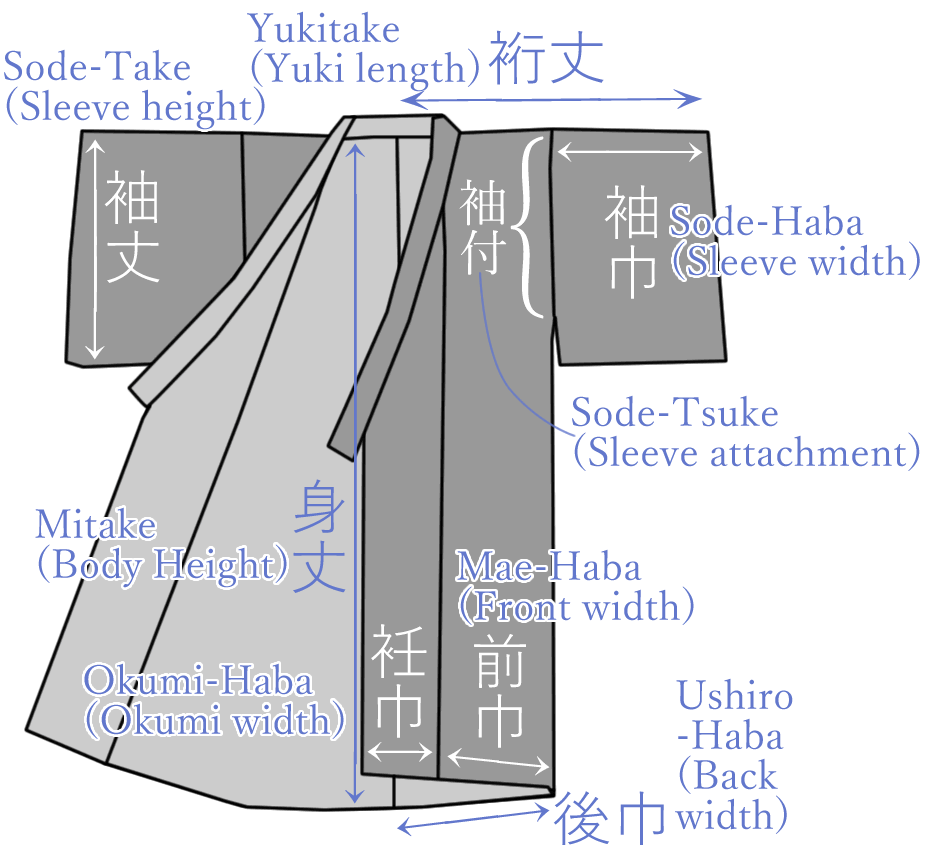
These are the measurements you’ll need when having a kimono made for you.
About Body Width
If your build is very slim or very full-figured, these measurements matter a lot:
- Front width (mae-haba)
- Back width (ushiro-haba)
- Okumi width (okumi-haba)
Body length (mitake) is affected too. With a fuller figure, the body’s curves make the path longer, so you often need a longer mitake than you’d get by simply basing it on height.
Likewise, if you’re very slim and straighter through the torso, mitake may end up a little shorter.
Preferred Length
At formal occasions such as wedding seating, having the ankles clearly exposed can look a bit unfinished.
On the other hand, at lively events like summer festivals, a shorter yukata can look perfectly natural — and if it’s so long that the ankles disappear, it can even look a bit heavy or stuffy.
For casual wear, feel free to follow your preference.
A common way to think about it: shorter for a lively, stylish look; longer for a chic, grown-up look.
As a basic rule, aligning with the ankle bone is a safe choice.
It Also Depends on What You Practice
Nihon Buyo (Japanese Classical Dance)
In Japanese classical dance, there are gestures that involve pinching the sleeve opening, and the movement is often made more beautiful by taking
- Yuki (sleeve span)
- Sode-take (sleeve length)
a little longer.
That said, for certain roles, a shorter cut may be better.
Tea Ceremony
In tea ceremony, you repeatedly stand and sit in a small tea room, so stepping on the hem and falling would be serious trouble.
You could also damage important utensils.
So rather than going long for a chic look, mitake is usually kept right at ankle-bone length.
Too short, on the other hand, can look improper as etiquette — so “just right” really is just right.
What Is Yuki?
Yuki is a word you’ll hear often. It’s the distance from the protruding bone at the nape of the neck to the protruding bone at the wrist.
Lower your arm at about 45 degrees, and measure with a tape running over the shoulder, over the elbow, and over the wrist.
If the wrist bone is clearly exposed, the kimono can look too short and tight in the sleeves.
As a rough guide: about 2 cm short feels “a little short, but acceptable”; about 5 cm short feels “definitely too short.”
Sleeve Width and Shoulder Width
Yuki = sleeve width + shoulder width
In general, the sleeve side is taken about 1–2 cm wider than the shoulder side. For a slim build, you might give the sleeve 3–4 cm more; for a fuller build, a near 1:1 balance is often better.
What Is Mi-haba (Body Width)?
You may have heard phrases like “the mi-haba isn’t enough.”
That width means:
Mi-haba = front width + back width + okumi width
Each of these can be fine-tuned individually.
Okumi Width
That said, okumi width is basically 15 cm.
That’s largely because a bolt of kimono fabric (tanmono) is about 36 cm wide, and it’s cut lengthwise in half:
15 cm + about 3 cm seam allowance ≈ 18 cm
and
18 × 2 = 36
— so it fits the bolt width neatly.
Adjusting that 15 cm width should be a last resort.
With Western dress fabric you’re free to change it, but given the history of working with tanmono, widening only the okumi too much can look unnatural.
How to Adjust Mi-haba
So when you need more mi-haba, start by widening
- Front width
- Back width
first.
A back width that exceeds the shoulder width usually means a quite full figure — not common, but entirely possible for overseas customers and others.
For example, with a 36 cm bolt and 1 cm seam allowance on each side, shoulder width becomes 34 cm.
You rarely take a back width beyond that 34 cm.
As for front width: in theory you could also take up to 34 cm, same as the back — but a slightly narrower front than the back usually looks more natural. So if the back is 34 cm, around 32 cm for the front tends to work well.
Of course, the mi-haba your body actually needs comes first; balance is secondary to that.
Measuring When You Don’t Have a Kimono or Yukata Nearby
You can measure along the curves of your body with a tape measure — but what I often ask customers is:
Even a women’s one is fine — is there any kimono or yukata around you at all?
If you can try anything on, you’ll get a rough sense of mitake, yuki, and mi-haba.
Realistic Measurements
From there, if you have an obi — men’s or women’s, it doesn’t matter — tie it for now.
You’ll often find the hem rises more than you expected. (In other words, mitake starts to feel short.)
Then try
- Walking
- Sitting
- Lying down
- Getting up
repeatedly, and spend about half an hour to an hour in it.
Eventually the hem creeps up.
Even if you looked perfectly neat at the start, walking can leave the shins and calves fully exposed.
I think the measurements after you’ve made a small adjustment for that shift are closer to real life.
For a photo studio, the measurements right after a perfect dress might be fine — but everyday wear is another story. ^^